Learning Outcomes:
After completing this lesson, students will be able to:
i. Define substrate-level phosphorylation and its role in cellular metabolism.
ii. Explain the mechanism of substrate-level phosphorylation, including the coupling of exergonic reactions to ATP synthesis.
iii. Discuss the importance of phosphoenolpyruvate (PEP) and phosphoglyceraldehyde (PGAL) in both photosynthesis and respiration.
iv. Identify examples of metabolic pathways that involve substrate-level phosphorylation.
Introduction:
Substrate-level phosphorylation is a fundamental process in cellular metabolism that allows cells to capture energy from exergonic reactions and store it in the form of adenosine triphosphate (ATP), the energy currency of cells. Unlike oxidative phosphorylation, which involves the electron transport chain, substrate-level phosphorylation directly transfers a phosphate group from a high-energy intermediate molecule to ADP, forming ATP. This process occurs in both photosynthesis and respiration, highlighting its versatility in energy extraction.
i. Mechanism of Substrate-Level Phosphorylation:
Substrate-level phosphorylation involves two key steps:
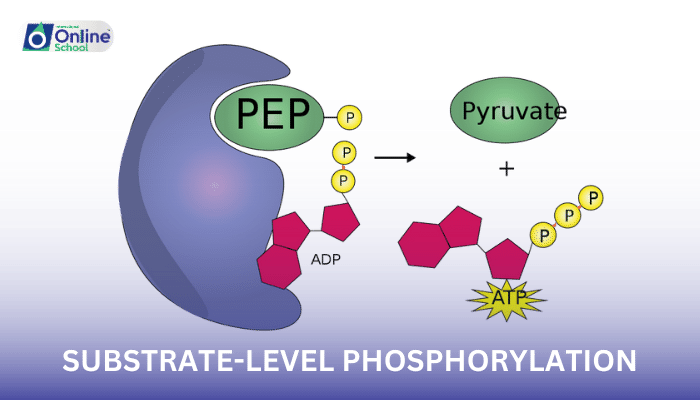
Formation of a High-Energy Phosphate Intermediate: An enzyme catalyzes an exergonic reaction that converts a substrate molecule into a phosphorylated intermediate, a molecule with a high-energy phosphate group.
Phosphate Transfer to ADP: The high-energy phosphate group from the phosphorylated intermediate is directly transferred to ADP, forming ATP. This transfer is catalyzed by another enzyme.
ii. Role of Phosphoenolpyruvate (PEP) and Phosphoglyceraldehyde (PGAL):
Phosphoenolpyruvate (PEP) and phosphoglyceraldehyde (PGAL) are two key intermediates involved in substrate-level phosphorylation.
PEP: PEP is a high-energy phosphate intermediate formed in glycolysis, the breakdown of glucose. In plants, PEP is also generated during photosynthesis in a process called carbon fixation. The hydrolysis of PEP can directly generate ATP.
PGAL: PGAL is a phosphorylated intermediate formed in both photosynthesis and respiration. In photosynthesis, PGAL is produced during the Calvin cycle, where it is used to synthesize glucose. In respiration, PGAL is generated from glucose-6-phosphate during glycolysis. The oxidation of PGAL can generate NADH, which can later contribute to ATP synthesis through oxidative phosphorylation.
iii. Examples of Metabolic Pathways Involving Substrate-Level Phosphorylation:
Substrate-level phosphorylation is a common mechanism for ATP synthesis in various metabolic pathways:
Glycolysis: Glycolysis, the breakdown of glucose, generates two ATP molecules through substrate-level phosphorylation.
Photosynthesis: In the Calvin cycle of photosynthesis, substrate-level phosphorylation occurs during the regeneration of RuBP, the carbon dioxide acceptor.
PEP Carboxylase Reaction: In plants, PEP can be carboxylated to form oxaloacetate, a key intermediate in the Krebs cycle. This reaction is catalyzed by PEP carboxylase, and it generates ATP as a byproduct.
iv. Importance of Substrate-Level Phosphorylation:
Substrate-level phosphorylation plays a crucial role in cellular metabolism by providing a direct mechanism for ATP synthesis. It is a versatile process that occurs in various metabolic pathways, allowing cells to capture energy from a range of exergonic reactions. The production of ATP through substrate-level phosphorylation is essential for powering various cellular processes, including biosynthesis, movement, and signal transduction.
Substrate-level phosphorylation is a fundamental metabolic process that directly generates ATP from exergonic reactions. It is a key mechanism for energy extraction and utilization in cells. The involvement of PEP and PGAL in both photosynthesis and respiration highlights the versatility of substrate-level phosphorylation in energy conservation. Understanding this process provides insights into how cells extract and utilize energy to sustain life.
